Up Where the Cloud Ends: Chasing Dorset's Valley Fog on Foot
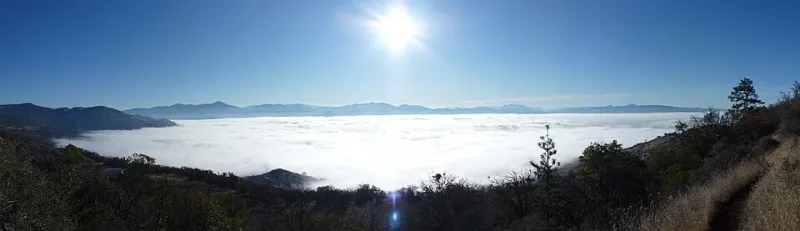
Photo: Little Mountain 5, CC BY-SA 3.0, via Wikimedia Commons
Fog gets a bad press. It cancels flights, delays ferries and makes the morning school run feel like a game of blind man's buff. But in Dorset, on the right morning, fog is the best thing that can happen to a walker. It pools in the vales, hides the caravan parks and turns ordinary hills into islands. The trick is not to sit in it. The trick is to climb out of it.
This is a winter-morning pursuit, not an all-day expedition. You want a cold, clear night, light winds and a forecast that hints at valley mist rather than blanket drizzle. Then you want to be on a hill before sunrise, or shortly after, with a headtorch, decent boots and a flask. It will be colder up top than you think. It will also be worth it.
How the trick works
A fog inversion is simple enough. Cold, dense air drains into the valleys overnight while slightly milder air sits above it. If there is little wind to mix things up, the valleys fill with cloud and the ridges stay clear. Dorset is made for this. The Blackmore Vale, the Frome valley and the low ground around the Stour can all disappear under a white blanket while the chalk and greensand tops are in bright, brittle sunshine.
It is not an exact science. You can climb a hill and find yourself still inside the cloud, or above a thin grey smear that never quite becomes the full white sea. Go anyway. A foggy hill is rarely dull, and the moment the cloud shifts is one of the quiet thrills of a Dorset winter.
Bulbarrow Hill
Start with the big, easy one. Bulbarrow Hill, west of Blandford, has a proper viewpoint and roadside parking near the top, which means you can be above the Blackmore Vale within minutes of leaving the car. On a good morning the vale is a lake of cloud with church towers and tree tops poking through. The ground is high and exposed, so wear an extra layer and keep dogs close near livestock. It is not a long walk, but it does not need to be. Ten minutes of cold air and a thermos is a perfectly respectable outing.
Pilsdon Pen
Pilsdon Pen is the highest point in Dorset, though it never feels like a mountain. The National Trust car park at the foot gives you a short, steepish climb to the Iron Age ramparts, and from there the views open over west Dorset towards Devon. In inversion weather the low ground can be completely hidden while the ramparts stand clear. The paths hold water, so gaiters or waterproof boots are sensible. This is a good one for a sunrise arrival, with a headtorch for the first stretch and a flask for the top.
Golden Cap
Golden Cap is the highest point on the south coast and a very different beast. From Seatown or the Langdon Hill car park, the climb is short but sharp, and the reward on a foggy morning is a view over a cloud-filled Lyme Bay with the sea just visible beyond. The path will be muddy and slippery after rain, and the clay can be treacherous on the descent. Take your time, especially if you are starting in the dark. It is not a hill for flip-flops or a hangover, but for a clear, cold morning it is hard to beat.
Hambledon Hill
Hambledon Hill rises above the Stour and the Blackmore Vale, and its ramparts give you plenty of places to stand and watch the cloud roll about below. Parking is limited in Child Okeford, so arrive early and be considerate of the village. The climb is steep but short, and the top is wide enough to find a quiet corner out of the wind. This is a good one for anyone who likes their history served with a side of meteorology: Iron Age banks, winter light and a valley full of fog.
Eggardon Hill
Eggardon Hill, near Dorchester, is one of the most accessible big views in Dorset. There is roadside parking near the earthworks, and from there it is a gentle walk onto the ramparts. On a foggy morning the surrounding valleys can be lost entirely while the hill itself stands clear. It is a fine place for a short circuit, a bit of flask administration and a look at the cloud from above. The ground is uneven and muddy in places, so watch your footing on the banks.
Nine Barrow Down
For a ridge rather than a single summit, head to Purbeck. Nine Barrow Down runs above Swanage and Studland, and on the right morning you can walk along the top with cloud filling the low ground on both sides. Park at Ulwell or near Studland and take the steady climb up to the ridge. The views over Swanage Bay and the Purbeck hills are excellent, and the path is generally good, though it can be muddy after rain. It is a longer outing than the others, so allow a couple of hours and check the weather before you commit.
The flask-and-timing bit
In mid-November, sunrise is around half past seven, so you do not need a ridiculous alarm. Aim to be on the hill for first light, or within an hour after. Check the forecast for clear skies and light winds, and look for mentions of valley fog or mist. Take a headtorch even if you think you will not need it, wear layers you can add or remove, and carry a flask of something hot. Tell someone where you are going. The paths will be wet, the ground will be cold and the views will be worth it.
Dorset does not need dramatic mountains to do drama. It just needs a cold night, a valley and a hill to climb. Set the alarm, make the flask and go and stand above the cloud. You will be back in the fog soon enough.