Where the Branches Shake Hands: Walking Dorset's Holloways in Winter
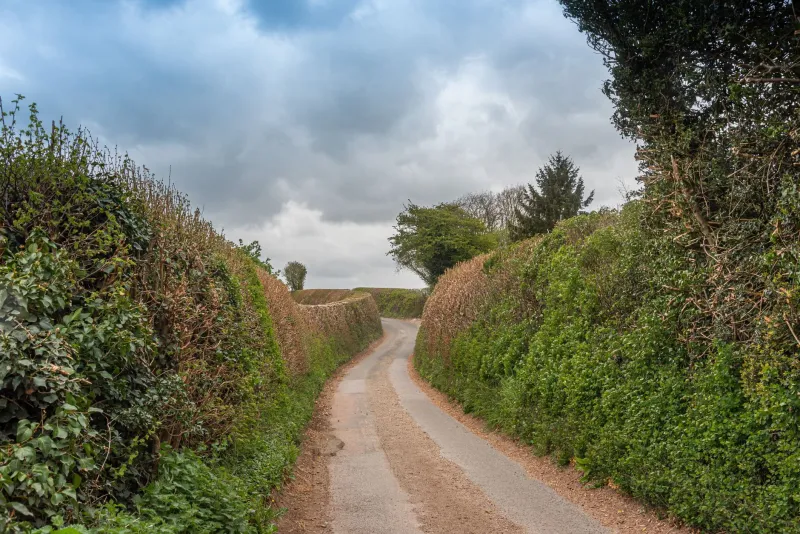
Most lanes ask you to look ahead. A holloway asks you to look up. Somewhere past Symondsbury, a few miles inland from Bridport, the hedges stop being hedges and start being walls, and the walls keep rising until the branches on either side are close enough to shake hands overhead. The light goes green, then brown, then a sort of dim gold. The traffic noise disappears. You feel, quite unreasonably, that you have stepped off the map rather than along it.
That is the trick of these routes. They are not scenic in the postcard sense. They are old in a way that is hard to photograph and easy to feel.
What a holloway actually is
A holloway is a lane that has sunk. Not through earthquake or design, but through use. Centuries of feet, hooves, cartwheels and runoff have cut a channel into soft ground, and once a channel starts it deepens itself: water gathers in it, the sides slump, the track wears further down. In parts of Dorset the result is a passage three or four metres below the level of the surrounding fields, with root systems exposed along the banks like the ribs of a boat.
The geology helps. Around Bridport you are walking on the Bridport Sand Formation — soft, yellow-brown stuff that yields to a boot heel and positively dissolves under a winter downpour. Add a long history of livestock being moved to market and you get lanes that were already ancient when the turnpikes came along and stole their traffic. Many were bypassed, left to the badgers and the mud, and that is precisely why they survive.
So when you drop into one, you are not walking beside history. You are walking in the groove it left.
The walk: Symondsbury, Hell Lane and back over the hill
Start in Symondsbury, a small village just west of Bridport that is easily reached on foot from town — about twenty minutes of pavement and then lane. If you are coming by bus, the Bridport services drop you within a mile or so; from there it is all boot leather.
Head up through the village and pick up the route towards North Chideock. The lane you want is marked on OS Explorer 116 and known locally as Hell Lane, which sounds more dramatic than it is. The name is probably a corruption or a bit of old humour rather than a reference to anything infernal, though the sunken section does have a reputation for smugglers and other romantic nonsense that nobody has ever quite proved. Believe what you like. It suits the place.
The climb is gentle but sustained, and the holloway section is short enough to walk twice if you like. Do walk it twice. Going up, you notice the banks. Coming down, you notice the roof.
At the top, the lane spills out onto open ground with views back over the Bride Valley and, on a clear day, the sea beyond Eype. Turn back along the footpaths via Colmer's Hill if you want the full postcard — the famous conical hill with its little clump of trees — or take the shorter return through the fields. Either way it is roughly three to four miles, which in winter is about right: enough to warm you through, not enough to have you walking home in the dark.
Finish at the pub in Symondsbury. You will have earned it, and your boots will need the time to dry.
How to read the landscape on the way
Walking a holloway well is mostly a matter of noticing what the ground is telling you.
Look at the width. A narrow, deeply cut lane means foot traffic and packhorses. A wider, shallower one suggests carts, and probably a later date. Some lanes change width halfway up, which usually means a boundary moved or a route was diverted.
Look at the banks. Those raised earth ridges either side are often original field boundaries, centuries older than the lane itself. The hedge on top may be hazel, ash, field maple, spindle — the usual Dorset mix — and the coppicing stools at the base are often the oldest living things you will pass all day.
Look for water. Springs seep out of the banks in winter, and where they do, you will find hart's tongue fern and moss and a particular sort of green that only exists in wet shade. That seepage is also what cut the lane in the first place. The water is still at work.
Look at the roots. Exposed root plates on the bank are a rough calendar. The bigger and more sculpted they are, the longer that bank has been eroding.
Mud, boots and winter light
The mud is not a drawback. It is the whole point — it is the reason the lane is there. But it does mean you should dress for it. Waterproof boots with a decent tread, trousers you do not love, and a walking pole if you are unsure on slippery ground. Gaiters are not ridiculous in January.
Go after a dry spell if you can, but do not wait for perfection. Holloways are at their best in low winter sun, when the light comes in sideways and picks out the texture of the banks. The trees are bare, which means you can see the shape of the lane rather than a green tunnel. Frost helps too: it stiffens the mud and turns the whole thing into something out of a woodcut.
Take a torch. Winter afternoons go quickly in a sunken lane, and the light that seems generous on the ridge can be gone by half three.
And take your time. These are not routes for a personal best. They are places to stand still in for a minute, listening to water move through the leaf litter, and to remember that the ground beneath your feet was shaped by people who never once thought of it as a landscape. They were just going to market.
That is the odd gift of a Dorset holloway. It makes the past feel like somewhere you could walk to.