What the Storm Left Behind: A Beginner's Fossil Morning at Charmouth
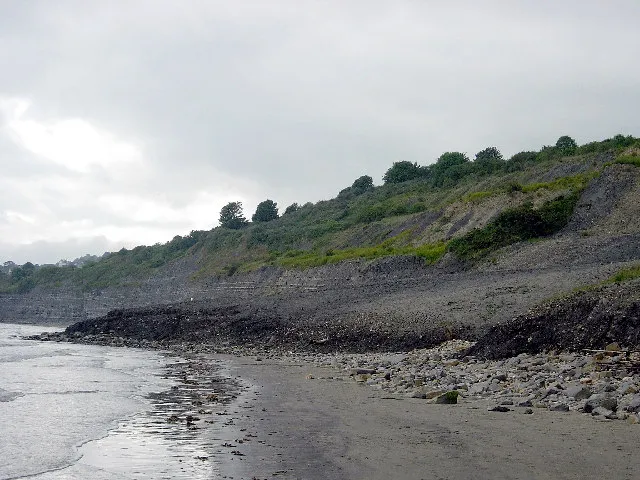
Photo: Val Vannet, CC BY-SA 2.0, via Wikimedia Commons
Charmouth in November is a lesson in lowered expectations and how wrong they are. The car park is half full, mostly with dog walkers and one man in a very serious waterproof who is already three hundred yards down the beach, bent double. The sea is the colour of old pewter. Somewhere behind you, the cliffs of Black Ven are quietly falling apart, which is the whole point of the place.
This is not the fossil hunting of the museum gift shop — the polished ammonites on a velvet pad, priced at eleven pounds. This is the other thing: a wet morning, a cold nose, a pocket of grey stones, and the small electric jolt of realising one of them is a spiral.
Why the off-season does the work for you
Fossils at Charmouth do not sit conveniently in the cliff face waiting to be noticed. They arrive. The soft blue-grey shales of Black Ven slump and slide, the sea sorts the debris, and every winter storm rearranges the beach like someone shaking out a drawer. What was buried in October can be lying loose on the shingle in December.
Summer, ironically, is the worst time to look. The beach has been walked over by thousands of pairs of trainers, the good stuff has gone home in carrier bags, and the Heritage Coast Centre is four deep at the counter. In winter you get the volunteers' full attention, a beach that has been freshly turned over by weather, and the strange luxury of hearing the sea rather than a hen party.
Tide first, fossil second
Before you look at a single stone, look at a tide table. Charmouth has a big range and a low-water beach that only exists for a few hours a day. The ledges and the shingle flats out towards the water are the good ground, and they are also the ground that fills up fastest when the tide turns.
Go on a falling tide. Aim to be on the beach two to three hours before low water, and give yourself an hour's margin to get back to the slipway. Do not walk out to the distant ledges in the belief that you'll be quick. Do not carry on round the point towards Lyme because the ground looks interesting — that's Black Ven's debris field, and it is not a place to be caught by a rising sea.
Wind matters as much as tide. A stiff south-westerly will push water in faster than the table suggests, and it will also throw spray over the very ledges you were planning to crouch on. If it's blowing and the tide is mid-range, pick a shorter visit and enjoy it more.
Reading the beach
Walk slowly. This is genuinely the whole technique. Most beginners march to the waterline, look at the horizon, and then look vaguely downwards and see nothing but stones.
The stones are the point. Look at the top edge of the beach, where the shingle has been pushed into a low ridge — that's where light, flat material collects. Look at the small runnels and scars where water has cut down through the sand. Look at fresh mud fans below the cliffs after rain; they look unpromising and are often excellent. And look at what is not a pebble. Fossils on Charmouth beach tend to be darker, denser, finer-grained and heavier than the beach around them.
Give yourself a rule: pick up nothing for the first twenty minutes. Just look. Your eye calibrates surprisingly fast.
What you're actually looking for
Ammonites are the headline act and the easiest to learn. The little coin-sized ones — flat, ribbed spirals that look like a fossilised Catherine wheel — are everywhere once you're tuned in. Larger ones turn up too, sometimes with a sheen of iridescent pyrite that makes them look like they've been varnished. Belemnites are the other common find: bullet-shaped, cigar-like guards from an animal a bit like a squid. Children love them. Adults pretend not to.
Less obvious but everywhere: crinoid stem sections, which look like little stone washers; fragments of fossil wood; shells; the occasional shark tooth if you are very lucky and very patient. Bone from larger marine reptiles turns up, but rarely, and not on a first visit. If you find something you think is bone, take a photograph where it lies, don't lever it out, and take it to the Heritage Coast Centre.
A caution on the glittering pyrite ammonites: they are beautiful and they will crumble in a damp kitchen drawer within a year. Keep them dry, or don't take them.
The rules, briefly
The beach sits within a Site of Special Scientific Interest, and the fossil code here is not complicated. Collect from loose material on the beach. Don't hammer into the cliffs, the ledges or any fossil still in place in the rock — that's where the science lives. Don't dig into the mudflows. Take only what you'll actually keep, and give the rest back to the beach.
Where to stand, what not to do
Keep clear of the base of the cliffs, full stop. The rock falls without warning and the mud is deeper than it looks. Stay off the dark, smooth mudflows even when they seem firm. Wear boots with grip, not trainers. Keep one eye on the sea rather than both eyes on the ground, and if the water starts to look closer than it did five minutes ago, stop looking at stones and start walking.
Mobile signal down on the beach is patchy. Tell someone where you're going and when you'll be back.
Warming up afterwards
There is a bakery on Lower Sea Lane that does a very good pasty, and a pub that does a very good pint, and the Heritage Coast Centre will identify your finds for free and be genuinely pleased to do it. Lyme Regis is a few minutes up the road if you want a second coffee, a wet-weather wander along the Cobb, and the museum's rather good fossil collection to compare notes against.
Guided fossil walks run through the winter on set days, cost very little, and are worth doing once even if you resent being told what to do. You'll learn more in two hours than in a fortnight of squinting.
Go on a cold morning, take gloves, leave the hammer at home, and expect nothing in particular. Charmouth is at its most generous when it thinks nobody's looking.