Splash Course: Six Dorset Fords That Come Alive After Rain
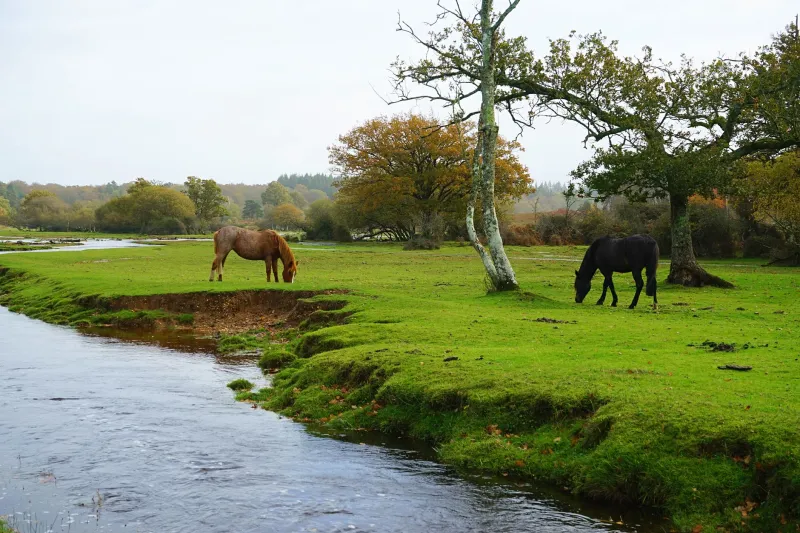
There is a sound a Dorset lane makes in mid-November that no other month quite manages: not quite a stream, not quite a road, somewhere in the middle and getting bolder by the hour. The tarmac dips, the hedge bottoms go dark, and the lane starts carrying water rather than traffic. Fords are the honest version of this — places where the county stops pretending and simply lets the river have right of way.
Handled sensibly, they are also one of the best free days out in Dorset after a wet spell. Here are six crossings worth a detour, with notes on parking, walking and the pub at the end of the puddle.
First, read the water, not the satnav
A ford is weather, not scenery. The rule of thumb is dull and reliable: if you cannot see the bottom, do not drive it. Brown, quick water hides potholes, undercut edges and the occasional piece of farm kit that has no business being there.
If you intend to drive a crossing, walk it first — boots on, a stick in hand, prodding the far edge where the tarmac crumbles away into gravel. Depth is only half the story; flow is the other half. Ankle-deep water moving at jogging pace will shift a small car sideways. Water over the sill of an ordinary hatchback means turn round, and a Land Rover grinning at you from the far bank is not a depth gauge.
Some crossings have gauge posts. Most do not. Take the hint where they exist, and take the obvious precautions where they do not: this water is snowmelt-and-rain cold well into December, the stones are greasy, and a phone in a coat pocket is a phone at the bottom of a river. Check the Environment Agency flood warnings before setting out in earnest — a ford that is a laugh on Saturday morning can be a closed road by Sunday lunchtime.
1. Fiddleford Mill, near Sturminster Newton
The Stour does not so much cross the lane at Fiddleford as take it over. There is a mill, a weir, a cluster of proper stone buildings and a ford that turns genuinely splashy after a few days of rain — the sort of crossing that makes children in the back seat go quiet, then loud again.
Park at the mill end and walk the last stretch rather than committing the car. The thatched Fiddleford Inn is a short stroll away and does the job handsomely on a wet afternoon, and the riverside paths give you a decent leg-stretch either side of the water. Drive it only when the Stour is behaving; the gravel shifts about, and the exit ramp is steeper than it looks from the approach.
2. Hammoon, near Sturminster Newton
A couple of miles downstream, Hammoon is barely a village — a handful of thatched roofs, a manor, a church and a lane that drops into the Stour over clean gravel. It is the quietest ford on this list and probably the prettiest, especially with the low sun behind the bare trees.
There is no pub in the hamlet, so treat this as a flask-and-boots crossing: walk out from Sturminster Newton along the riverside paths, splash through, and come back via the lanes. If the river is up, do not be a hero about it. The footpath bridges nearby exist for a reason, and nobody has ever regretted the detour.
3. Cerne Abbas
Water is the whole point of Cerne Abbas. The stream runs down through the village, past flint walls and ducks, and the ford at the lower end of the village is a lovely, shallow, slightly theatrical thing — the Giant presumably watching from the hill with his usual expression.
There is a footbridge for anyone with sense. Park in the village car park rather than on the narrow lanes, then walk: up to the Giant if your legs are willing, along to the abbey ruins if they are not. The New Inn and the Giant Inn are both within splashing distance, and both understand what a wet walker wants.
4. Sydling St Nicholas
The Sydling runs clear over chalk and the ford at the Dorchester end of the village is shallow, wide and flanked by a footbridge — perfect for the cautious and the camera-wielding. After heavy rain it has a bit of push to it, but it is rarely a drama.
Park considerately in the village; this is a working place, not a car park. Then walk up the valley, which is one of Dorset's great gentle strolls — watercress, flint, cows and a lane that keeps losing the stream and finding it again. The Greyhound provides food, a fire and the correct end to proceedings.
5. Evershot
The Frome starts small up here, and the ford at the bottom of Evershot is a modest, pretty crossing that looks shallower than it is. In low water it is a splash; after a wet week it is a proper little river with opinions.
Walk it before you drive it, and note that the approach is narrow with a tight turn — not one for a large car and a confident mood. The Acorn Inn, which Hardy fans will recognise as the Sow-and-Acorn in Tess of the d'Urbervilles, is a minute or two away and far too easy to settle into. Walk up through the village to the church afterwards to earn it.
6. Powerstock
West Dorset's quieter answer to all of the above. The stream comes down through the village, crosses the lane by the pub and disappears into the trees, and after rain the whole corner smells of leaf mould and wet stone. It is small, but it is genuine.
Park near the church and walk in. The Three Horseshoes is the obvious reward, and the lanes and paths up onto Powerstock Common give you an hour or two of proper mud before you get it. Do not attempt the crossing in a low-slung car after a fortnight of rain; the exit is rough and the water hides it.
After the splash
Take a towel for the dog, a spare pair of socks for you, and a thermos for the bit where you stand on the footbridge pretending you are not going to get your boots wet again. Check the water on foot, turn round when it is over the sill, and never follow someone else in just because they made it.
The reward is the bit afterwards: wet boots steaming by a pub fire, a pint that tastes better than it has any right to, and the knowledge that you have found the one part of Dorset where the river gets the last word.