Wet Stone, Loose Bolts: Six Dorset Mills That Still Turn for a Living
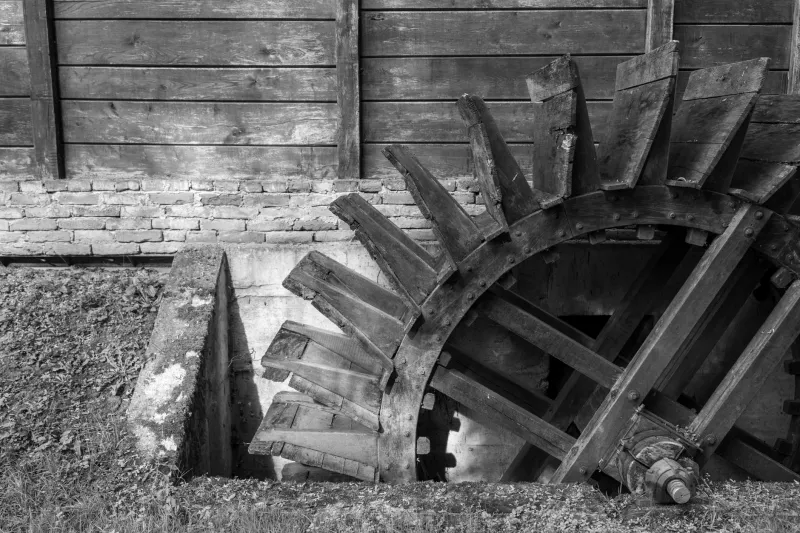
There is a right season for looking at watermills, and it isn't July. In high summer the leat is a trickle, the wheel sulks, and the whole business looks like a museum piece waiting for its tea. Come back after a fortnight of rain and the place has a temper on it. The weir roars, the hatch is up, and the wheel has actual work to do. You can hear the wooden teeth clacking from the lane.
Dorset is quietly well supplied with the things. Some still grind flour you can buy; others just sit in the wet with their sluices half-open, which is its own kind of pleasure. What follows is six, roughly west to east, with a note on what to listen for and a walk to bolt on afterwards. Ring ahead — mills keep odd hours, and a wheel that turns on Sunday may be silent by Tuesday.
Sturminster Newton Mill: the one that feeds itself
Just below the town, the Stour slides past a mill site that was already old when the Domesday clerks wrote it down. The present building is mostly eighteenth-century with later patching, and on milling days the stones genuinely run — you can watch the grain go in and come out as flour you're allowed to take home.
Listen for the damsel. It's a small iron arm that taps the shoe, shaking grain into the eye of the stone — tick, tick, tick, the sound of a mill being fed. Ask whoever's on duty to point out the hopper, the shoe and the tun, and you'll never look at a bag of flour the same way again. The mill sits a short hop off the Stour Valley Way, so a loop along the river and back up into the town is easy and flat.
White Mill, Sturminster Marshall: the one you look up in
The National Trust mill on the Stour is not always turning, and that's fine — its party trick is overhead. The roof is a great ribcage of elm, cut from the estate and shaped while it was still green, and it's worth a visit on a grey day purely for the smell of old timber and stone dust.
Outside, the mill race and the chalk-and-timber walls tell you how the whole thing was plumbed. Stand downstream and look back at the tailrace: that's where the water leaves, having done its job. The riverside path here is properly muddy in winter, which is the point. Bring boots, not trainers.
Cann Mills, Melbury Abbas: the one that still trades
Down a lane below Melbury Hill, near Shaftesbury, this is a working mill in the real sense — stoneground flour, sacks in the yard, and a shop that sells the stuff by the bag. If the wind is in the right quarter you can smell warm grain from the road before you see the wheel.
It's a useful reminder that watermills were never quaint. They were factories, and some of them never stopped. The lane in from the village is narrow and steep and worth walking rather than driving, and the ridge above gives you a view across to Hambledon and the edge of Cranborne Chase. Combine the two and you've got a two-hour outing that finishes with flour in the boot.
Town Mill, Lyme Regis: the one that came back
After decades derelict, the mill on the River Lym was brought back to life by volunteers at the turn of the century, and now grinds again in the middle of town. There are guided tours, three sets of stones, and a yard that has quietly filled up with a brewery, an art gallery and a decent place to eat.
The Lym is a tiny river doing a lot of work in a short distance — walk upstream along the path towards Uplyme and you'll pass the old mill ponds and leats that fed the town's trades. It's a twenty-minute amble, and on a wet morning you'll have it more or less to yourself.
Mangerton Mill, west Dorset: the one with ducks
Tucked into the folds below Powerstock, this is the mill visit that suits people who like their history with a scone. The wheel turns, the pond has waterfowl on it, and the old buildings have been colonised by craft studios and a tea room.
It's not the place for a hardcore lesson in gearing, but it is the place to sit with a pot of tea while somebody else's wheel does the work. Afterwards, walk up onto Eggardon Hill — an Iron Age fort with ramparts like folded blankets and a view that explains why every mill in the valley is where it is. The lanes back down are steep and hedge-bound, so take the footpath.
Fiddleford Mill, near Sturminster Newton: the one with the manor next door
A handsome eighteenth-century mill on the Stour, still carrying its wheel and its mill house, with the river doing its usual patient work alongside. The real draw is the pairing: a few hundred yards away stands Fiddleford Manor, a medieval hall with a soaring timber roof, free to visit and usually empty.
Do both in one go. Manor first, mill second, then the pub. That's a winter afternoon sorted, and you'll have seen six hundred years of Dorset building in about six hundred yards.
How to time it right
Three rules. First, go within a few days of heavy rain: a mill is only interesting when the water has some push to it. Second, check before you travel — many run their stones only on set days, often weekends, and a lot close entirely between November and Easter. Third, ask questions. Mill volunteers are unreasonably pleased to be asked about penstocks.
The words worth knowing
The leat is the channel that brings water to the wheel; the tailrace takes it away. The hatch or penstock is the gate that controls the flow. Above the stones, the hopper holds the grain, the shoe feeds it, and the damsel shakes the shoe. The stones themselves are dressed — sharpened — by hand, a job that used to occupy whole winters.
Learn five of those words and any mill door in the county opens a little wider. That, and a pair of boots that don't mind a wet field, is really all the equipment you need.